The FullCircles Blog

Multi-contributor blog on the topic of reusing, freecycling… garbology in general

June 5: World Environment Day


Theme 2011

Forests-Nature At Your Service-cover one third of the earth’s land mass, performing vital functions and services around the world which make our planet alive with possibilities. In fact, 1.6 billion people depend on forests for their livelihoods. They play a key role in our battle against climate change, releasing oxygen into the atmosphere while storing carbon dioxide. Thousands of activities are organized worldwide, with beach clean-ups, concerts, exhibits, film festivals, community events and much more.This year’s global host, India – a country of wide biodiversity.[2]


Amplify
posted by Gub in Environment and have No Comments

Every little bit doesn’t really help

This is a jolting wake up call.  Thanks for bringing this to our attention on your Facebook Page, Manuel Costa.

Eric
==========


Every little bit doesn’t really help

By Marq De Villiers, Ottawa Citizen May 25, 2011


Cheerfully mundane energy-saving suggestions like unplugging chargers and hanging out laundry belie the sheer scale of the problem of addressing climate change.

Every little bit helps, no?”

Well, no.

The notion that “every little bit helps” is just a comforting illusion.

One of the main dissonances in the climate change debate, on the increasingly rare occasions we are now having a debate at all, is that between the cheerfully mundane remedies pressed on us all, and the sheer scale of the problem to hand: if we all did a little, such as cutting back on standby power, using a clothesline instead of a dryer and so forth, the cumulative effect will add up to a lot, won’t it? But this is, to use a cheerful quote from Cambridge physicist David MacKay, “crazy innumerate codswallop.”\

Read more: Every little bit doesn’t really help.

Enhanced by Zemanta
Amplify
posted by Gub in Environment,Foodstuffs for Thought,Simple wisdom and have No Comments

Day 5: International Compost Awareness Week (Vermicomposting)

Red wrigglers: trouble-free and useful pets!

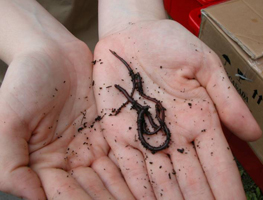
Red wrigglers © Jardin botanique de MontréalDid you know that table scraps and yard waste account for about 40% of our garbage? That’s really too bad, because we’re throwing out valuable natural fertilizer that ends up in landfills. Vermicomposting (worm composting) is a simple way to recycle most of this organic material.

What is vermicomposting?

As its name suggests, this composting method relies on worms, more specifically a type of worms known as red wrigglers (Eisenia foetida). Safe inside a covered bin, they transform food scraps and plant waste into high-quality compost. You can vermicompost year round indoors or on a balcony in summer (red wrigglers can’t survive freezing temperatures).

[More via Vermicomposting Green Pages [Montréal Botanical Garden]

Enhanced by Zemanta
Amplify
posted by Gub in Composting,Environment,Freecycling and have No Comments

May 1-7, 2011: International Compost Awareness Week

International Compost Awareness Week! May 1-7 2011

Get involved! Time to start planning your ICAW events for 2011.  The International Compost Awareness Week Committee of the USCC congratulates Heather Lawrence on winning this year’s poster contest.

To see what others are saying and for more information on ICAW and how to get involved, click here

via US Composting Council.

Enhanced by Zemanta
Amplify
posted by Gub in Composting and have No Comments

How Low Flow Can You Go? « Water Conservation Challenge’s Blog

How Low Flow Can You Go? « Water Conservation Challenge’s Blog.

Water Conservation Challenge’s Blog

An annual campaign to increase water awareness and encourage conservation by challenging ourselves to severly reduce our personal usage of water for an entire month (March).
The goal is to live on 25 litres of water per day for the entire month of March. The average North American uses about 330 litres per day while the average European uses around 250 litres per day so by taking this up you would be severely limiting your water use.

http://www.howlowflowcanyougo.com/


Enhanced by Zemanta
Amplify
posted by Gub in Environment and have No Comments

Garbage Island

“People say, why don’t you just go and clean it up? Like it’s a giant parking lot? Well there’s no way. There’s no way.”  The calculation would require every man woman and child on the plant to be in charge of 100,000 pickup truck loads to clean up the garbage patch.

The Garbage Island in the Pacific ocean does not look like I thought it would. I pictured a huge (the size of Texas?) floating mass of plastic. I watched this doc about the garbage patch and saw what it REALLY looks like. Not at all what you would think, but equally as devastating.

If you are interested, take a look. I jumped ahead to about the halfway mark to get to the good stuff , up to the 45 minute mark then you can see what is going on. It’s pretty disgusting.

We HAVE changed the composition of ocean water. These are scary things, people! Think about this next time you use plastic, I know that I will.

Garbage Island

Enhanced by Zemanta
Amplify
posted by sara in Environment,Resources,Waste Management and have Comments (2)